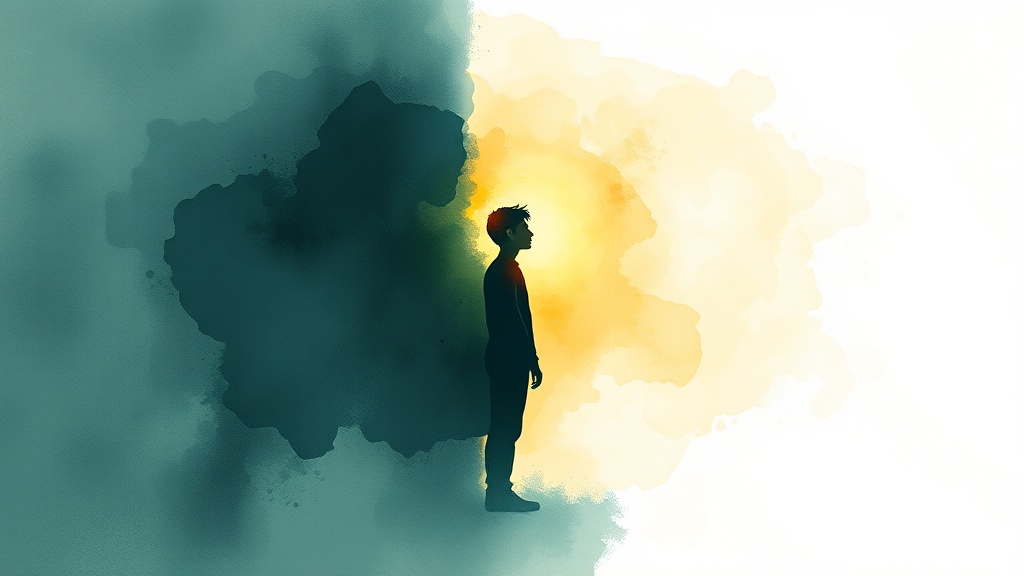
The Hidden Connection Between Depression and Self-Criticism
Depression doesn’t always look like sadness. Sometimes it looks like going through the motions — getting up, going to work, saying “I’m fine” — while feeling absolutely nothing underneath. And sometimes, if you listen closely, there’s a voice in the background narrating the whole thing: You’re not doing enough. Everyone else has it together. What’s wrong with you?
That voice — the inner critic — and depression are more connected than most people realize.
The Critic That Never Takes a Day Off
We all have an inner critic. It’s the part of us that evaluates, compares, and judges. In small doses, it can be motivating — it pushes us to improve, to try harder, to meet our own standards. But when it goes unchecked, it becomes relentless. And living under that kind of constant internal pressure is exhausting.
In Internal Family Systems therapy, we see the inner critic as a “manager” part — one that’s trying to prevent pain by keeping you in line. It believes that if it criticizes you hard enough, you’ll avoid failure, rejection, or shame. The irony is that all that criticism often produces the very feelings it’s trying to prevent.
How Criticism Feeds Depression
Here’s the cycle: the critic tells you you’re falling short. You feel bad about yourself. That bad feeling drains your energy and motivation. You accomplish less. The critic notices and doubles down. You feel worse. And the loop continues.
Over time, another part may step in — one that numbs things out, shuts things down, or simply withdraws. That’s often what depression feels like from the inside: not dramatic despair, but a kind of collapse. A part of you pulling the emergency brake because the internal pressure has become too much.
What Changes When You Hear the Critic Differently
Most people I work with have spent years trying to argue with their inner critic, or trying to drown it out with productivity, substances, or distraction. The IFS approach does something counterintuitive: we get curious about the critic instead.
When clients slow down and ask the critic what it’s really afraid of, the answers are often surprisingly tender. “I’m afraid you’ll be rejected.” “I’m afraid you’ll end up alone.” “I don’t want you to feel the way you felt as a kid.” The critic isn’t a villain — it’s a protector that’s using the only strategy it knows.
When we can acknowledge that — without agreeing with the criticism — something loosens. The inner pressure decreases. And space opens up for other feelings to surface: grief, relief, sometimes even hope.
Depression Isn’t Laziness
I want to name something directly, because too many people carry this belief: depression is not laziness, weakness, or a character flaw. It’s your system responding to overload — internal or external. When the weight gets heavy enough, parts of you start shutting down to survive. That’s not failure. That’s a kind of intelligence.
The path forward isn’t to push harder. It’s to understand what’s been pushing you down.
Starting Somewhere
If you recognize yourself in any of this — the numbness, the critic, the heaviness — know that it doesn’t have to stay this way. Therapy isn’t about slapping a positive attitude on top of real pain. It’s about getting underneath the surface and finding out what’s really going on.
If you’d like to explore what that could look like for you, book a free consultation and we’ll start with a conversation. No pressure, no judgment — just two people figuring out whether working together makes sense.